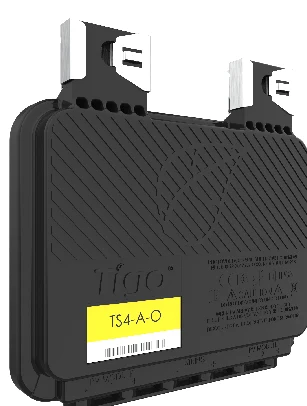
Tigo prints "511-340612-2001 0.6/1.2 m MC4 1500 V/1000 V" (part number, cable lengths IN/OUT, connectors, VMAX UL/IEC) in the ordering table of its TS4-A-O (725 W) datasheet, Rev. 1.2 and Rev. 1.0.
Printed within "Standards compliance US FCC; IC Canada; CE-EMC; CE-LVD; CE-RED; CE-RoHS; TUV-IEC 62109; ANSI/UL/CAN 1741; UL1741 PVRSE/PVRSS; US NEC 690/12; ANSI/UL/CAN 3741; CSA 22.2-106; CSA 22.2-330 PVRSE/PVRSS". These are the maker's statements; no listing record was checked.
Printed as "Communications Wireless 2.4 GHz1 and/or PLC2", with the footnotes "1 Using Tigo Access Point (TAP) and Cloud Connect Advanced (CCA)" and "2 Using Tigo RSS transmitter power-line communications".
Printed as "TS4-A-O 725 W 80 V 16 A 22 A 1000/1500 V" (Max. Power 725 W) in the quick start guide (002-00218-00 Rev. 1.3) and "Maximum output power (PMAX) 725 W" in the datasheet (002-00216-00 Rev. 1.2).
Printed as Max. Input ISC 22 A (Max. Input IMP 16 A) in the quick start guide row "TS4-A-O 725 W 80 V 16 A 22 A 1000/1500 V" and "Input current (IMP /ISC) 16 A/22 A" in the datasheet. 22 A is the short-circuit (ISC) figure.
Printed as Max. Input V 80 V in the quick start guide row "TS4-A-O 725 W 80 V 16 A 22 A 1000/1500 V"; the datasheet prints "Input voltage range (VMP) 12 – 80 V" and a maximum system voltage of 1000 V/1500 V depending on UL or IEC certification.
Printed as "(TS4-A-O) Operating temperature range -40 – 70 °C (-40 – 158 °F)" in the quick start guide and "Operating temperature range -40 – 70 °C (-40 – 158 °F)" in the datasheet.
Printed as "Rapid shutdown time limit <30 sec.", "UL 1741 PVRSE standard certified Yes" and, in Standards compliance, "UL1741 PVRSE/PVRSS; US NEC 690/12". The datasheet notes that a Tigo Access Point (TAP) and Cloud Connect Advanced (CCA) are required for rapid shutdown.
Tigo Energy's own TS4-A-O (725 W) datasheet (Rev. 1.2, dated 2026-08-24), linked from Tigo's TS4-A-O product page and captured October 3, 2026. One specification column serves every part number; the ordering table lists six part numbers that differ by cable lengths and connector. Manufacturer claims, not independent tests.
Archived copies
Archived copy of a document published by Tigo Energy. Copyright retained by the publisher; kept for reference and verification only, no endorsement implied. To ask for its removal, email legal@chargedreviews.com.
Tigo Energy's own installation quick start guide for the TS4-A-O, TS4-A-S and TS4-A-F (725 W) (Rev. 1.3, dated 2025-05-29), linked from Tigo's TS4-A-O product page and captured October 3, 2026. Its specification table gives one row per model. Manufacturer claims, not independent tests.
Archived copies
Archived copy of a document published by Tigo Energy. Copyright retained by the publisher; kept for reference and verification only, no endorsement implied. To ask for its removal, email legal@chargedreviews.com.
Tigo Energy's earlier TS4-A-O (725 W) datasheet (Rev. 1.0, dated 2025-04-18) on Tigo's own document host, the revision Signature Solar links from its TS4-A-O listings; captured October 3, 2026. Rev. 1.2 supersedes it. Manufacturer claims, not independent tests.
Archived copies
Archived copy of a document published by Tigo Energy. Copyright retained by the publisher; kept for reference and verification only, no endorsement implied. To ask for its removal, email legal@chargedreviews.com.
Archived copy of a document published by Tigo Energy. Copyright retained by the publisher; kept for reference and verification only, no endorsement implied. To ask for its removal, email legal@chargedreviews.com.
TS4-A-O (725 W) datasheet, 002-00216-00 Rev. 1.2, Tigo Energy
Archived copy of a document published by Tigo Energy. Copyright retained by the publisher; kept for reference and verification only, no endorsement implied. To ask for its removal, email legal@chargedreviews.com.
TS4-A-O (725 W) datasheet, 002-00216-00 Rev. 1.0, Tigo Energy
Archived copy of a document published by Tigo Energy. Copyright retained by the publisher; kept for reference and verification only, no endorsement implied. To ask for its removal, email legal@chargedreviews.com.
Reclaim 10-30% of the power you don't know you're losing.
Software
4/5
Reliability
5/5
Build quality
5/5
Ease of install
4/5
I knew I had a couple of shaded panel, because we have about 600 trees on our 5 acres, and our neighbor's property is at least as tree-dense as ours. My greenhouse array of 20 Waaree 590W panels (arranged in stacked portrait layout) is surrounded in a canopy, but only one tree is right at the array. The rest are ranging from 50' away to over 100' away, but I didn't realize just how shaded certain panels of the array were, until I put TS4-A-O optimizers on a few panels at a time.
My array is a 5S2P configuration, so 4 strings of 5, in 2 paralleled MPPTs. MPPT1 has always "seemed" unshaded, but we're about to find out for sure.
MPPT2 I've always known had "some" shade, but I never knew just how bad it was, until all 10 panels of MPPT2 had optimizers, and I could see each individual panel throughout the sun arc of the day. The lower set of 5 barely making anything until 10+AM, and now when I look back at the historical data, before I had optimizers, it makes sense.
How do TS4-A-O's benefit you?
1) total module-level visibility.
2) enabling rapid shutdown.
3) reclaim every watt of power feasible from your array.
I've seen as low as 13% reclaimed and as high as 30%, but if you have mismatched panels, it could be more. My ROI is about 14-20 months on just the cost of the optimizers + the CCA logger. Definitely worth it, in my opinion.
And you can integrate Tigo EI with Home Assistant or your EG4 monitor app.
They do need to work on the ease of installation. There are plenty of videos you can watch, but until you go through the commissioning process yourself, you won't understand exactly why it's not as intuitive as it could be. Some things are just done out of order. Some things need to be done through the "view" screens, that should be feasible through the "edit" screen flow. But, I have zero complaints about quality or capabilities. Excellent product, and I'll use them on all my array builds.