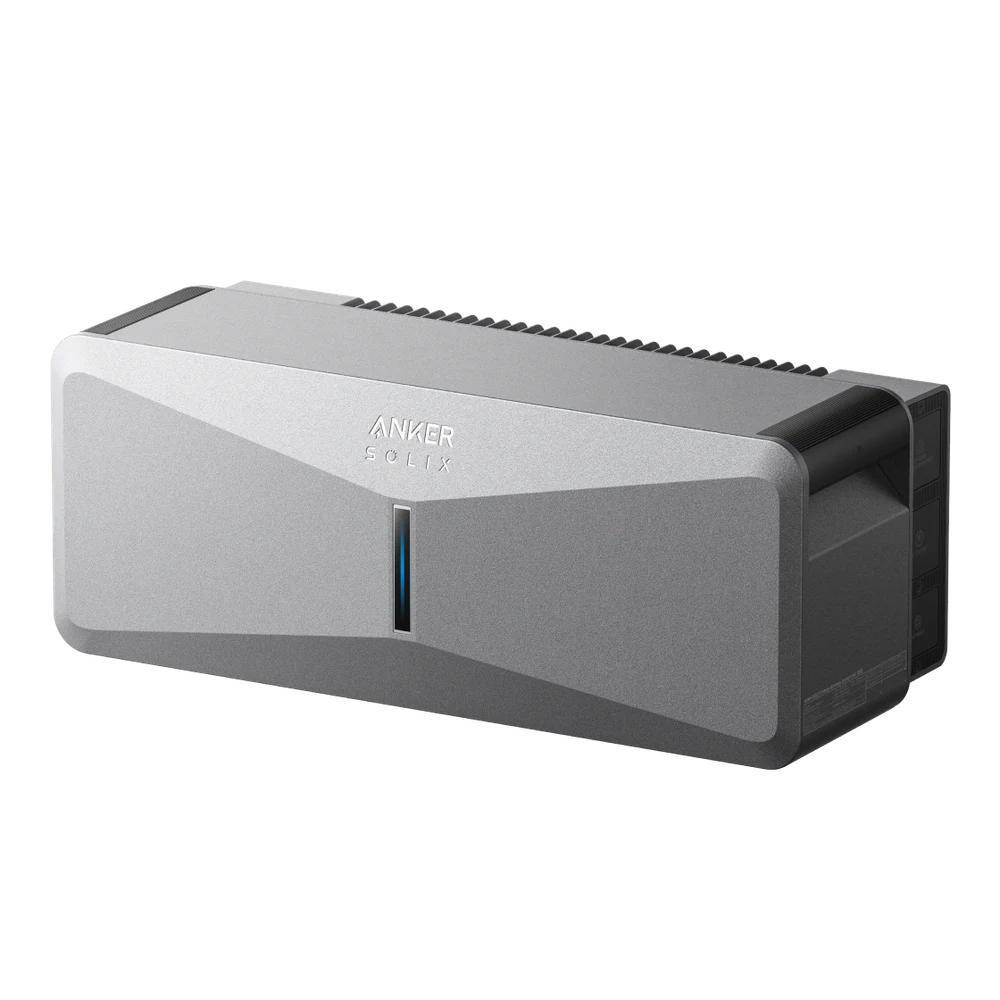
This manufacturer is listed as Anker SOLIX. Manufacturing entities, factories, cell origin and model-specific ownership relationships have not been audited.
Product certificates and company management certificates are tracked separately. No company management certificates have been reviewed for this manufacturer yet.
Anker's own documentation says the Solix F2000 will output power down to -4 degrees Fahrenheit. But in my repeated experience it stops all input/output once it clicks from 34 degrees to 33 degrees. If you attempt to power it up it will flash the temperature and not turn on. Even with the solar input unplugged, it still will not turn on until I've warmed it up above 34 degrees. I understand that it is limited from charging (input) in freezing temperatures, but the output is supposed to continue working down to -4. When it shuts off it is effectively not able to even power basic lighting for a few hours. I contacted Anker 4 separate times and included videos and photos and each time they responded with their specs that sort of prove my point. But that is it. I've asked if a software update is available, but according to Anker my Solix F2000 software is current. All of their newer models are showing the same specs so it has me hesitant to upgrade in hopes of solving my situation. I also purchased their expansion battery and that as well is unusable as it can only be utilized when recognized by an operable F2000.
This is from their manual:
Output: -4°F-104°F / -20°C-40°C
Input: 32°F-104°F / 0°C-40°C
I've had this unit for about a year now. I've done various tests and uses.
My old gripe with my 12 volt inverts is that they usually won't power up the coffee maker or toaster oven. The Anker F3800 has power in spades and can easily handle extended bake cycles on the toaster oven. I've also used the F3800 for charging the EV (using the onboard Ground-Neutral bond mode). The Anker can only handle 24amps at 240 volts (235volts measured by the car). The 3800wh battery dumps quickly at this rate.
I mainly charge this unit from solar. I've put in the full 1200watts from solar using 6 x 200watt panels in 2s3p configuration. Recently I've found that directly plugging in an external 48volt 100ah battery will put 1150w into the unit (50 short of the max 1200w).
Other experiments I've done show that the external battery port will only accept a maximum of 2400w of power before the inverter shuts down. It will also not run at the full 24amps for EV charging because of this. Adding 1 Anker external battery plus the 3rd part external battery allow for the full 24amps for EV charging but the inverter will shut down once the batteries drain to the point where the 3rd party battery starts providing more than 2400w of power. The best use of the 3rd party 48volt battery is to use it on the solar charge ports and let the 1150w per port offset the drain on the main battery.
A reliable power station and an easy to use solution.
Purchased the SOLIX 2600 and one expansion battery along with the 400 watt portable solar panel to use at my small remote camp in far Northern WI. Runs a few lights, coffee maker, microwave, refrigerator and keeps phones, laptop and small electronics charged. Quick and very easy setup. System will operate for about 4 days and is supplemented with a small gas generator when needed. The only disappointment is the Anker solar panel; I average about 280 watts on sunny days. Will be replacing with permanent panels. I have had no problems with the system to date, very satisfied.
I own an Anker SOLIX E10 system with five B6000 expansion batteries, providing a total of 30 kWh of battery storage. My original system included the E10 inverter and two expansion batteries, and I purchased this additional battery through Amazon.
The battery worked perfectly for the first few weeks. Then I received a D10 battery fault error. I rebooted the system, and everything returned to normal. About a month later, the same D10 error appeared, and once again, rebooting resolved the issue.
In October, the D10 error returned, but this time a reboot didn't resolve it. Shortly afterward, the battery also reported a D32 fault. Something to note, these errors occurred when charging above 90%. I charged it many times above 90% SOC, but the errors all happened when above 90%. Might be related, might not.
I contacted Anker support and uploaded the system logs for troubleshooting. Within approximately 24 hours, Anker responded, and within 48 hours, I received a tracking number for a replacement battery module.
Less than a week after initially contacting support, the replacement battery arrived, was installed, and was operating normally alongside my other four batteries. Mind you this is a 125 pound battery module.
While I was disappointed that a relatively new battery experienced a hardware issue, but I would rather the error happen when it is newer instead of years down the road.
In this case, Anker handled the situation exceptionally well in my opinion. There was no lengthy back-and-forth, no unnecessary troubleshooting, and no drawn-out warranty process. They reviewed the logs, recognized the problem, and quickly shipped a replacement.
I've been very pleased with the overall performance of my E10 system. Anker's customer support and warranty service fixed the issue quickly in my opinion.
Solid and reliable battery, but limited by missing software features
Overall this battery has performed well for me over the last couple years that I've had it. I don't have any complaints about the overall build or design. The things that stand out cons are:
1. Fan noise: When charging via solar input port (either from actual solar panels or from a DC power source) the cooling fan inside the unit can be loud. It sounds to me like the fan is kind of undersized, and the fan curve isn't very smooth so the noise can be quite annoying as it switches between fan speeds.
2. Software features: the connected app works fairly well, and it's nice that it's possible to connect the battery to a wifi network so that the SoC and input/output can be viewed remotely. However, I think this battery falls behind competitors when it comes to configurability. I would love a way to set a charge "reserve", where, for example, it only uses the AC input if charge falls below a set percentage, and relies on solar/DC input otherwise. Many other batteries, including some others in Anker's lineup, are able to do this; it feels like something that was left out of the software just to try and ladder people up to more expensive/higher-capacity models.
For the last 6 months or so, I've used this battery effectively as an inverter/buffer connected to a 100Ah golf cart LFP battery. The golf cart battery is charged by a solar MPPT charge controller, and outputs via an XT60 connector into the Anker's solar input. This lets me store up and use a couple days' worth of solar input from a 400W panel, which I can use to run AC and other devices in my living room. Overall it's held up well, and I'm still able to use it for backup in the case of power outages, or if I want to have battery backup on a road/camping trip in my car.
Served its purpose during a 3 day outage. No problems
I bought the generator adapter and it recharges quickly.
The nice thing with the generator adapter is you can keep the 240VAC inverter engaged while recharging.
Designed for camping or emergency lighting with excellent clever engineering. Two rechargeable lights lie in a charging dock under the front panel along with a telescoping pole. There is a screw hole on the top ro attach the pole. The lights can be attached magnetically to the pole. Mode selections allow for area lighting or a more focused beam flashlight. Battery life on these is easily hours. The LED on the front of the unit has three brightness settings. This on board lighting combined with 12V socket and AC inverter and solar input make this a remarkably versatile unit. During a prolonged outage this unit was able to run my fridge (~125w cont with ? Large startup surge) for about 4 hours on a full charge. The quality is awesome, it feels solid, not flimsy junk. The carry handles are comfortable. The app is easy to install and navigate, and is nicely polished. Has bluetooth and wifi for remote monitoring. I think this is a terrific product overall and would absolutely buy it again.
Great for a backup battery for a small home for short periods.
I purchased the F3800 plus with a BP3800 expansion battery as a home backup, couple with solar and a 120v generator.
Build quality - external only. I ain't opening this thing up. It is built like a tank, built to be bumped and moved around. The unit itself has an extension handle and wheels making it pretty easy to move around. I strap a BP3800 expansion battery on top with a ratchet strap, which negates the handle and makes it heavy to move, but still doable.
Capacity- it will definitely output 6000 watts if they are constant loads. If usage is 3000 and you add an 1800 watt microwave it's going to pop off. The AC power is designed for larger outputs. If you plug a fridge into this thing it seems the AC inverter consumption on small
Loads does pretty bad.
It will definitely take the solar input well. I currently have 2000 watts of solar panels with another 920 in reserve. I have hooked all up to both inputs and they do well.
I run a 3.5ton Lennox central AC inverter Florida with an Easystart Flex soft start. It has no problem running this for 6 hours with the solar production. I have a lot of gas appliances so that is my big load.
Charging - If you have a 240v generator you can charge and maintain loads at the same time. Solar also stays up during 240v loads.
If you have only AC sources, it shuts off the 240v loads during charging.
Pros- this is an easy option for those who are unable or unwilling to build DIY setups. It's expansion batteries managed their own balancing and charging. No other equipment required.
If you need 12,000 watts of output, adding a second power station
It's mildly portable within your home, but this isn't something you would take camping or load into your car. It's very heavy.
Support - Anker support has been awesome and interactive. I had troubles with their generator adapter and they actually pushed an update to the software to rectify the issue.
Cons- it is very expensive per KWH, the expansion batteries being roughly the same price as the entire unit and only adding 3.8kwh. The software is getting better but it feels like Anker has left this behind in favor
Of its E10 system. As an example, the Anker smart generator will make use of the step start function but won't charge direct DC on the F3800 plus.
3rd party expansion options will void your warranty, and I paid for this thing unlike many of the YouTube guys showing you how to hack these. Don't do it.