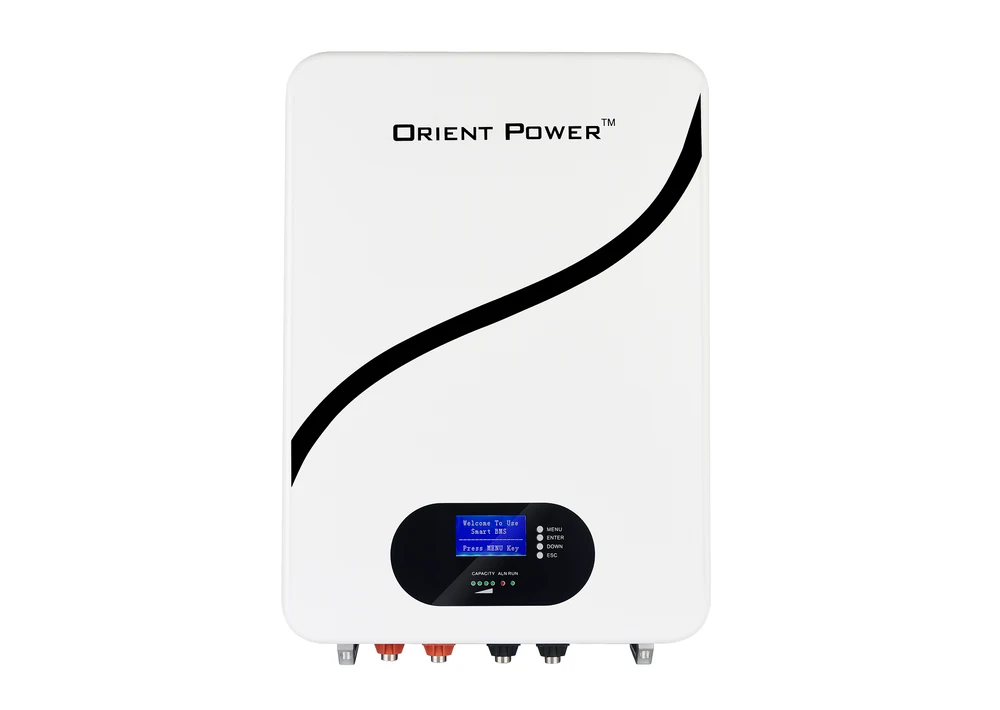
About brandOrient Power is the LiFePO4 battery brand sold by Opsolar Limited at www.opsolarbattery.com, which lists a US contact and a factory in Zhuhai.
SKU detail
locator: Product page, SKU; user manual and spec sheet, Model
conditions: Printed as "SKU: 48100PW" on the product page and "Model 48100PW" in the user manual and spec sheet. No other ordering code is printed.
The user manual names the charger and inverter settings for the "16S LiFePO4 Battery Option"; the spec sheet is titled "LiFePO4 Battery Specification".
Where: User manual, 3.4.4 Other Wire Connection; spec sheet title
Printed as "Terminal Type M8x4" in the user manual and on the spec sheet. The manual says the battery has 2 positive and 2 negative terminals, each pair connected internally.
Manual and spec sheet give different weights: 55 kg and 50 kg. The user manual prints Approx. Weight 110 lbs (55 Kg); the spec sheet prints 50 Kg and the product page 110LBS(50kg), so both documents print 110 lb but different kilograms. The product page gives the rack separately as 2.9 kg.
Printed as "Approx. Weight 110 lbs ( 55 Kg )" in the user manual, the primary source: an approximate figure. The spec sheet prints 50 Kg and the product page "110LBS(50kg)", kept below as an alternative.
Where: User manual, 2.2 Battery Specifications, Mechanical performance
Sources
50 kg
Printed as "Approx. Weight 50 Kg" on the spec sheet and "Battery Weight 110LBS(50kg), rack 6.38LBS(2.9kg)." on the product page.
Printed as "7000 times more @80% DOD." on Orient Power's product page, read as at least 7000 cycles at 80% depth of discharge. No charge rate, temperature or end-of-life capacity is stated. Neither the user manual nor the spec sheet prints a cycle life.
W 420 × H 203 × L 580 mm / W 16.5 × H 7.99 × L 22.8 in converted
Printed as "Dimension (LxWxH) 22.8 x 16.5 x 8.0" (580x420x203mm)" in the user manual, "Dimension (LxWxH) 580x420x203mm" on the spec sheet and "(580x420x203MM)" on the product page; the millimeter figures are recorded.
The manual describes mounting to a wall with the mounting frame and 8 M8 screws on a firm wall thicker than 80mm; the product page prints "Wall mounted or lay on the rack is acceptable."
Where: User manual, 3.4.2 Mounting to a wall; product page
Maximum charge current differs: 100 A in the manual, 110 A on the spec sheet. The Orient Power user manual prints Maximum Charge Current 100 A; the spec sheet linked from the same product page prints 110 A. Neither document carries a revision or date.
Printed as "Maximum Charge Current 100 A" in the user manual, the primary source. The spec sheet prints 110 A, kept below as an alternative.
Where: User manual, 2.2 Battery Specifications, Charge performance
Sources
110 A
Printed as "Maximum Charge Current 110 A" on the spec sheet.
Recommended wire differs: 2 to 6 AWG in the manual, 6 AWG on the spec sheet. The user manual recommends 2 - 6 AWG connection wire; the spec sheet prints 6 AWG only.
Printed as "Recommended Connection Wire 2 - 6 AWG" in the user manual, the primary source. The spec sheet prints 6 AWG, kept below as an alternative.
Where: User manual, 2.2 Battery Specifications, Recommended Connection Wire
Sources
6 AWG
Printed as "Recommended Connection Wire 6 AWG" on the spec sheet.
BMS discharge cut-off current 130 A (1000 ms), high current warning 125 A; short circuit protection 300 μs; 125 A breaker on the positive loop Check note
BMS current limits differ: 125 A warning and 130 A cut-off in the manual, 105 A and 110 A on the spec sheet. The user manual prints a discharge high current warning of 125 A and a cut-off of 130 A (1000 ms); the spec sheet prints 105 A and 110 A (1000 ms).
Printed in the user manual as "BMS Discharge Current High Warning 125 A", "BMS Discharge Cut-Off Current 130 A (1000ms)" and "Short Circuit Protection 300 μs", and in 2.4.2 as a breaker on the battery positive loop rated 125A, acting as secondary protection in addition to the BMS. The spec sheet prints a 105 A high current warning and a 110 A (1000ms) cut-off current, kept below as an alternative.
Where: PDF pages 9, 11; User manual, 2.2 Battery Specifications, Discharge performance; 2.4.2 Breaker
Sources
BMS discharge cut-off current 110 A (1000 ms), high current warning 105 A; short circuit protection 300 μs
Printed on the spec sheet as "BMS Discharge Current High Warning 105 A", "BMS Discharge Cut-Off Current 110 A (1000ms)" and "Short Circuit Protection 300 μs".
Printed as "48100PW Battery designed for unlimited parallel (a Max 15 parallel if connected communication with inverter)": 15 is the maximum with inverter communication, and the address switch covers batteries 1 to 15. Without inverter communication the manual says parallel is unlimited.
Where: User manual, 3.4.3 Battery Parallel Connection; 4.3.1.2
RS485A (RJ45): communication with inverter; CAN (RJ45): communication with inverter; RS232 (RJ12): communication with PC; RS485B and RS485C (RJ45): battery parallel communication; DCT: 2 loops dry contact
Printed in the panel view and sections 2.4.4 to 2.4.7 of the user manual. The panel view labels both parallel ports RS485B; section 2.4.7 names them RS485B and RS485C. The manual says dry contacts are mostly unused.
Where: PDF pages 4, 11, 13; User manual, 2.3 Panel View; 2.4.4 to 2.4.7
Charge temperature differs within the manual: -5 to 55 °C in the table, 0 to 45 °C in the safety caution. The user manual specification table and the spec sheet print -5 to 55 °C; the manual's safety section 1.2 says the battery can be charged from 0°C to 45°C and warns against charging outside that range. The manual's installation section also asks for an ambient temperature from 0°C to 45°C.
Printed as "Charge Temperature 23 ~ 131 °F ( - 5 ~ 55 °C )" in the user manual specification table and on the spec sheet. The manual's safety section, 1.2 While Charging, gives a narrower range of 0°C to 45°C, kept below as an alternative.
Where: User manual, 2.2 Battery Specifications, Temperature performance; Spec sheet, LiFePO4 Battery Specification table
Sources
0 to 45 °C
Printed as "The temperature range over which the battery can be charged is 0°C to 45°C." in the manual's charging caution, which adds that charging outside this range may cause the battery to become hot or to break.
Printed as "Storage Temperature 23 ~ 95 °F ( - 5 ~ 35 °C )" in the user manual and on the spec sheet. The manual's storage section recommends 15°C to 25°C for long-term storage and a recharge every 3 months when stored at 0°C to 40°C.
Where: User manual, 2.2 Battery Specifications, Temperature performance; Spec sheet, LiFePO4 Battery Specification table
Printed as "Maximum Continuous Discharge Current 100 A" in the user manual and as "Maximum Continuous Dishcarge Current 100 A" (spelling as printed) on the spec sheet.
BMS charge cut-off differs: above 59.2 V in the manual, above 58.4 V on the spec sheet. Both documents print 3.7 V per cell, but the user manual gives the pack value as 59.2 V and the spec sheet as 58.4 V.
Printed as "BMS Charge Cut-Off Voltage > 59.2 V (3.7 V/Cell)" in the user manual, the primary source, with "Reconnect Voltage < 54.08 V (3.38 V/Cell)". The spec sheet prints "> 58.4V (or 3.7 V/Cell)" with a reconnect voltage below 54V, kept below as an alternative.
Where: User manual, 2.2 Battery Specifications, BMS Charge Cut-Off Voltage
Sources
58.4 V
Printed as "BMS Charge Cut-Off Voltage > 58.4V (or 3.7 V/Cell)" on the spec sheet, with "Reconnect Voltage < 54V (or all cell <3.38 V)".
Printed as "Discharge Temperature - 4 ~ 140 °F ( - 20 ~ 60 °C )" in the user manual and on the spec sheet; the manual's safety section 1.3 gives the same range, -20°C to 60°C.
Where: User manual, 2.2 Battery Specifications, Temperature performance; Spec sheet, LiFePO4 Battery Specification table
The panel view lists "RS485A Communication with inverter" and "CAN Communication with inverter". Section 4.3.2 says to use the RS485 port with MPP or LUX inverters and the CAN port with GROWATT, DEYE or VICTRON inverters, and to select the protocol in the BMS.
BMS discharge cut-off differs: below 40 V in the manual, below 43.2 V on the spec sheet. The user manual prints a cut-off below 40 V (2.5 V per cell); the spec sheet prints below 43.2 V (2.7 V per cell). Both print a 44.8 V low voltage warning.
Printed as "BMS Discharge Cut-Off Voltage <40 V (1 s) ( 2.5 V/Cell*16)" in the user manual, the primary source, with "Low Voltage Warning 44.8 V ( 2.8 V/Cell*16)" and "Reconnect Voltage >46.4 V ( 2.9 V/Cell)". The spec sheet prints a 43.2 V cut-off, kept below as an alternative.
Where: User manual, 2.2 Battery Specifications, Discharge performance
Sources
43.2 V
Printed as "BMS Discharge Cut-Off Voltage <43.2V (1 s) (or Cell <2.7 V)" on the spec sheet, with "Reconnect Voltage >47.2 V ( or all cell >2.95 V)".
Recommended charge voltage differs: 57.6 V in the manual table, 56 to 58.4 V on the spec sheet. The user manual specification table prints 57.6 V (3.6 V/Cell); the spec sheet prints a range of 56 to 58.4 V, the same range the manual gives for the charger output setting.
Printed as "Recommended Charge Voltage 57.6 V (3.6 V/Cell)" in the user manual specification table, the primary source. The manual's wiring section also sets the charger output to 56 to 58.4 V, and the spec sheet prints "Recommended Charge Voltage 56-58.4 V", kept below as an alternative.
Where: User manual, 2.2 Battery Specifications, Charge performance
Sources
56 to 58.4 V
Printed as "Recommended Charge Voltage 56-58.4 V" on the spec sheet.
49.45 L* (Calculated enclosure volume: W × H × D in mm ÷ 1,000,000)! Value needs confirmation: Manual and spec sheet give different weights: 55 kg and 50 kg.W: 420 × H: 203 × L: 580 mm / W: 16.5 × H: 7.99 × L: 22.8 in55 kg / 120 lb0.1 kWh/L* (Rated or usable capacity shown on this card ÷ enclosure volume)
Evidence score
4/100Missing details20% documented
The Evidence score uses the priorities you choose. It counts published documents, such as certificates and warranty terms, and it compares a documented figure with the best documented figure of the same kind. It does not count owner reviews, and it is not a verdict on product quality or on how many people have reviewed it. A low score can mean little is documented, or that a documented figure is below the best of its kind. Undisclosed data scores 0.
Missing details. This number counts only the evidence recorded so far. The source review for this product is not finished, or the maker has not disclosed enough, so the number can only go up.
Missing for this product: Certificates evidence needed; Warranty term needed; Warranty energy disclosure evidence needed; Cell model disclosure evidence needed.
48 V · Wall / floor · Rated capacity
The warranty term and the lifetime energy are each scored against the best documented value for a home storage battery: a value earns its share of that best, times the weight. A documented value always earns points; an undisclosed one earns 0.
Lifetime / capacity7,000 cycles4 / 20
Cycle rating disclosed · 20% weight
Documented cycle rating earns 20% of this criterion. More evidence is needed to compare lifetime MWh per kWh.
Research pending, 0 points: Certificates, Warranty term, Warranty energy disclosure, Cell model disclosure.
Computed from public specifications and evidence records. Warranty duration is not service quality; certificate evidence points are not a safety rating. Compatibility and installation limits still apply.
Location: 2.2 Battery Specifications; sections 1, 2.4, 3.4 and 4.3
Retrieved Oct 15, 2026
The 30-page Wall-mounted Battery User Manual linked from Orient Power's 48100PW product page, served from the site's own file host and captured on October 15, 2026. Its specification table names Model 48100PW. It is the primary source for this record. No revision or date is printed.
Archived copies
Archived copy of a document published by Opsolar Limited. Copyright retained by the publisher; kept for reference and verification only, no endorsement implied. To ask for its removal, email [email protected].
One-page spec sheet linked as Powerwall Battery Spec Sheet from Orient Power's 48100PW product page, served from the site's own file host and captured on October 15, 2026. Several values differ from the user manual (weight, maximum charge current, recommended charge voltage, BMS cut-offs, wire size). No revision or date is printed.
Archived copies
Archived copy of a document published by Opsolar Limited. Copyright retained by the publisher; kept for reference and verification only, no endorsement implied. To ask for its removal, email [email protected].
Location: Feature list; SKU; Specification & User Manual links
Retrieved Oct 15, 2026
Orient Power's own product page at www.opsolarbattery.com, captured on October 15, 2026. It prints a short feature list, the SKU and links to the spec sheet and user manual; its weight differs from the user manual. Manufacturer statements, not independent tests; the page carries no revision date.
Earlier revisions, archived captures and copies published by someone other than the manufacturer. Every one stays reachable.
Archived documents
Orient Power Wall-mounted Battery User Manual, model 48100PW (linked from the product page)
Archived copy of a document published by Opsolar Limited. Copyright retained by the publisher; kept for reference and verification only, no endorsement implied. To ask for its removal, email [email protected].
Orient Power 48100PW LiFePO4 Battery Specification (spec sheet linked from the product page)
Archived copy of a document published by Opsolar Limited. Copyright retained by the publisher; kept for reference and verification only, no endorsement implied. To ask for its removal, email [email protected].